Chinese Landscape Coloring Book - KDP
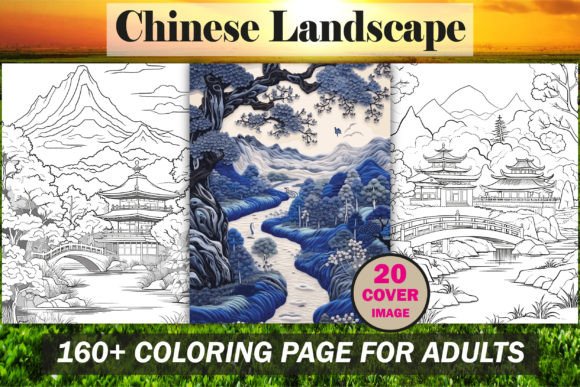
If you’ve ever scrolled through Amazon’s KDP dashboard at 2 a.m., searching for a low-content interior that stands out—not just another mandala or floral pattern—you already know how rare it is to find something both culturally rich and commercially viable. The Chinese Landscape Coloring Book - KDP isn’t just another coloring bundle. It’s 160 original, hand-crafted pages rooted in classical Chinese aesthetics—mountain mists, winding rivers, scholar’s pavilions, bamboo groves, and ink-wash silhouettes—all designed with one clear purpose: to help creators launch fast, sell consistently, and stand apart in a crowded niche.
Where This Bundle Fits in Real Life (Not Just on Paper)
Picture this: A freelance graphic designer in Portland spends two hours customizing cover #7 from the included 20 cover images, swaps in her brand font, uploads the interior as a ready-to-print PDF—and by Friday, her first “Chinese Landscape Coloring Book for Adults” is live on Amazon. No illustration software needed. No copyright worries. No pixelated exports. Every JPG file is 300 PPI, 8.5″ x 11″, pre-tested on KDP’s previewer so bleed, margins, and grayscale conversion behave exactly as expected.
Or consider a homeschooling parent in Austin who downloads the bundle not to resell—but to print weekly mindfulness breaks for her 14-year-old and herself. She prints page 42 (a mist-shrouded cliffside with layered rock strata) on thick cardstock, clips it to a clipboard, and they color side-by-side while listening to guqin music. No lesson plan required—just presence, paper, and intention.
Why It Works Beyond “Just Another Coloring Book”
Most adult coloring books lean into Western tropes: geometric patterns, fantasy creatures, or botanical realism. But this bundle taps into a quieter, deeper current—shanshui (mountain-water) tradition. That matters because it attracts a distinct audience: readers interested in East Asian art history, mindfulness practitioners drawn to wu wei (effortless action), retirees exploring cultural heritage, and even ESL teachers using visual literacy to spark conversation about nature metaphors in classical poetry.
That specificity becomes a quiet competitive edge. When someone searches “Chinese ink painting coloring book” or “Asian landscape coloring pages for adults,” your KDP listing doesn’t compete with 2,000 generic titles—it answers a precise query with precision.
Real Use Cases Across Roles
- For KDP Entrepreneurs: You’re building a catalog of themed low-content books. Instead of rushing three similar “Zen Garden” interiors this month, you publish one Chinese Landscape Coloring Book - KDP title, then rotate covers and subtitles (“With Calligraphy Prompts,” “Featuring Tang Dynasty Poetry Quotes,” “Minimalist Ink Style”) to create 5+ variations—all from the same 160-page core. No new artwork. Just smart repackaging.
- For Educators & Therapists: A licensed art therapist in Chicago uses pages 88–93 (a sequence showing seasonal transitions in a single valley) as grounding tools during anxiety-focused sessions. Clients don’t need art skills—just focus on line weight, negative space, and rhythm. The cultural framing adds narrative depth without prescriptive meaning.
- For Print-on-Demand Sellers: You run a small Etsy shop offering custom-printed coloring books. Instead of licensing third-party art (with murky usage rights), you use these files as your base interior. Add foil-stamped covers, lay-flat binding, and include a 1-page guide on “How to Read a Chinese Landscape Painting.” Suddenly, you’re selling experience—not just pages.
- For Content Creators: A YouTube creator filming “Slow TV Coloring Streams” downloads the bundle, selects 10 high-contrast pages ideal for screen clarity, and films a 4K timelapse of coloring page 117 (a solitary boat beneath a crescent moon). She links the full bundle in her description—turning passive viewers into customers.
What to Consider Before You Upload or Use It
This isn’t plug-and-play magic—it’s a tool that rewards thoughtful application. First, test one file before bulk-uploading. Even though all 160 JPGs are KDP-tested, your monitor calibration, PDF export settings, or cover-template alignment could shift contrast or crop. Print a physical proof copy—especially if you’re adding text overlays or bilingual captions.
Second, think beyond “coloring book.” Could page 29 (a lattice-window frame enclosing a distant pagoda) become a journal divider? Could page 104 (a crane in flight over reeds) anchor a gratitude worksheet? The designs have strong compositional bones—meaning they adapt well to planners, activity sheets, or even slide backgrounds for mindful breathing guides.
Third, consider your audience’s expectations. If you market this as “authentic Chinese landscape art,” avoid pairing it with stereotyped cover fonts or stock photos of dragons. Subtlety builds trust. A clean serif font, restrained color palette on the cover, and a short intro note about shanshui philosophy tells buyers you respect the source material—not just its commercial potential.
How Quality Translates to Outcomes
“High-quality print-ready PDF” sounds like boilerplate—until your first order arrives. One creator shared that her initial batch printed with faint gray lines instead of crisp black. Turns out, she’d exported from Photoshop with “Convert to sRGB” enabled, dulling contrast. The included PDFs skip that step entirely—they’re built from flattened, grayscale-optimized JPGs with embedded KDP-safe profiles. So when a customer orders a paperback, the mountain ridges hold their edge. The bamboo stalks don’t blur. And reviews start saying things like “lines are sharp even at 2x magnification”—which directly impacts repeat purchases and algorithmic visibility.
And those 20 cover images? They’re not just decorative. They’re strategic. Cover #12 uses negative space like a Song dynasty scroll—ideal for minimalist branding. Cover #19 layers translucent ink washes—perfect for targeting fans of abstract watercolor. You’re not choosing “a cover.” You’re choosing an entry point into a specific emotional or aesthetic response.
Final Thought: It’s Not About Filling Pages—It’s About Holding Space
The best low-content products don’t ask users to “do more.” They invite them to pause, observe, and reconnect—whether that’s a busy nurse coloring for five minutes between shifts, a retiree rediscovering fine motor control after surgery, or a KDP seller launching her fifth profitable title in under six months. The Chinese Landscape Coloring Book - KDP delivers that quietly. No slogans. No forced urgency. Just 160 invitations—to breathe, create, sell, teach, or simply sit with the quiet grandeur of a mist-laced peak, rendered in lines that honor centuries of artistic discipline.