Fairy Magic Garden Backgrounds for Cover
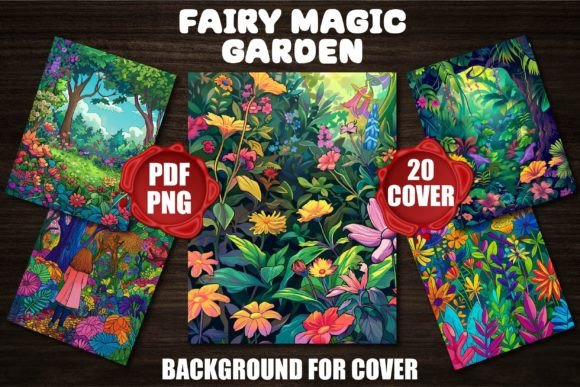
Imagine opening a book and instantly stepping into a sun-dappled glade where mushrooms glow faintly, ivy curls around ancient stone arches, and tiny wings shimmer just beyond the corner of your eye. That’s the quiet power of a well-chosen cover — not just decoration, but an invitation. Fairy Magic Garden Backgrounds for Cover delivers exactly that: 20 high-resolution, ready-to-use PNG backgrounds designed with intention, clarity, and creative flexibility at their core.
More Than Pretty Pictures — A Practical Creative Asset
These aren’t generic stock images. Each background is crafted with layered depth, soft atmospheric gradients, and subtle texture — details that matter when you’re designing for print or digital storefronts. At 300 DPI, they scale cleanly for KDP paperback covers (6” x 9”, 8.5” x 11”, and beyond), interior page headers, or even large-format coloring book covers. The transparent PNG format means you can overlay typography, illustrations, or photo elements without clipping or color bleed — a small but critical advantage in time-sensitive publishing workflows.
For indie authors launching fantasy novels or fairy tale anthologies, these backgrounds solve a real problem: balancing visual enchantment with professional polish. You don’t need advanced Photoshop skills to achieve cohesion — just drag, adjust opacity, and add your title in a complementary font. For journal creators or mindfulness publishers, the same files serve double duty: as serene cover foundations *and* as printable line-art pages (when paired with simple vector tracing tools).
Why Enchanted Aesthetics Are Resonating Now
It’s not just nostalgia driving interest in fairy gardens and whimsical nature motifs. Over the past five years, search data, design platform trends, and publishing analytics all point to a quiet but steady rise in demand for what we might call “gentle magic” — visuals that feel restorative, intentional, and emotionally safe. This isn’t about escapism alone; it’s about resonance. Readers browsing Amazon or Etsy increasingly pause on covers that signal calm, curiosity, and quiet wonder — qualities many associate with woodland settings, moss-covered stones, and softly blurred floral layers.
This shift aligns with broader lifestyle patterns: rising attention to mental wellness, growth in adult coloring communities, and a preference for tactile-feeling digital products (think matte-finish ebook covers or printable journals with organic textures). Even in professional contexts — like educators designing themed lesson planners or therapists creating guided reflection workbooks — there’s growing recognition that aesthetic tone shapes user engagement before a single word is read.
Designed for Real Workflows — Not Just Inspiration
What makes Fairy Magic Garden Backgrounds for Cover especially useful isn’t just its theme — it’s how the set is structured for actual use. All 20 files are named clearly (e.g., “FairyMagic_Garden_MossArch_Daylight.png”), avoiding confusing numbering or vague descriptors. They include varied light directions (morning mist, golden-hour warmth, soft overcast), compositional anchors (archways, winding paths, circular clearings), and tonal ranges — from cool lavender-greens to warm amber-moss palettes. That variety means you can match background mood to narrative tone: a mysterious twilight garden for a gothic fairy tale, a dewy morning scene for a hopeful coming-of-age story, or a sunlit clover patch for a lighthearted journal.
Importantly, these backgrounds avoid overcrowding. There’s intentional negative space — not emptiness, but breathing room — so your title, subtitle, and author name won’t compete visually. That’s a deliberate response to KDP’s thumbnail-driven discovery system: covers must communicate genre and feeling at 150px width. Cluttered or overly busy backgrounds fail there. These succeed because they guide the eye, not scatter it.
From Covers to Calm — Expanding the Use Case
While originally conceived for book covers, users consistently report repurposing these files in ways the creators hadn’t initially anticipated — a sign of thoughtful, modular design. Educators print them as thematic writing prompts (“Describe what lives behind this archway”). Therapists use them as grounding visuals during sessions, projecting soft-focus versions onto walls or embedding them in digital relaxation tools. Freelance designers incorporate elements into Canva templates for clients launching mindful productivity planners or seasonal gratitude journals.
For coloring book creators, the value multiplies: each background serves as both a finished cover *and* a starting point for hand-drawn extensions. Try importing one into Procreate or Affinity Designer, locking the layer, and adding custom line art — butterflies, hidden faces in bark, constellations woven through branches. Because the base is high-res and non-repetitive, the final product feels cohesive, not pieced together.
What This Means for Your Next Project
If you’re weighing whether to invest time in custom cover design or settle for generic templates, consider the long-term cost of indecision. A strong cover doesn’t just sell one book — it builds brand recognition across a series, supports cross-promotion, and increases click-through rates on ads. With Fairy Magic Garden Backgrounds for Cover, you gain consistency without rigidity: same visual language, different moods, all under one license.
There’s also a practical efficiency gain. Instead of spending hours adjusting lighting, masking foliage, or troubleshooting resolution issues, you start with production-ready assets. That reclaimed time adds up — whether it’s used to refine your manuscript, write better back-cover copy, or simply step away from the screen for a mindful walk outdoors (which, ironically, often sparks the very kind of ideas these backgrounds help bring to life).
A Note on Sustainability and Sensibility
Good design ethics extend beyond aesthetics. These files are optimized for fast loading and minimal storage — no bloated PSDs or unnecessary layers. They’re compatible with free and paid tools alike (GIMP, Photopea, Canva, Affinity, Adobe Suite), lowering the barrier for creators who prioritize accessibility over subscription costs. And because they’re digital-only, there’s no physical waste — a small but meaningful alignment with values increasingly important to conscious consumers and eco-aware publishers.
Finally, while “fairy magic” evokes playfulness, the underlying principle is grounded: respect for craft, clarity of purpose, and responsiveness to how people actually create, publish, and connect today. These backgrounds don’t promise overnight bestsellers — but they do offer something reliable, beautiful, and quietly capable: a foundation that lets your words, your voice, and your vision take center stage.