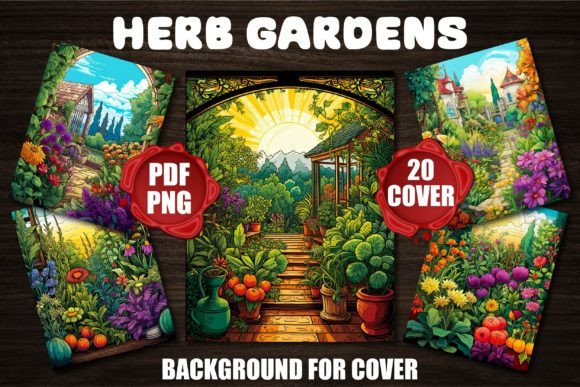
Herb Gardens Backgrounds for Covers
Imagine opening a coloring book and being greeted not by a generic floral border—but by the soft, sun-dappled quiet of a thyme-lined path, the delicate curl of rosemary stems against sage-green foliage, or the subtle texture of dried lavender heads suspended in line art. That’s the grounded calm Herb Gardens Backgrounds for Covers brings to your projects: 20 thoughtfully composed, high-resolution PNG covers—each rooted in real botanical presence, not just decorative repetition.
What This Collection Actually Is (and Isn’t)
Herb Gardens Backgrounds for Covers is a focused digital asset pack—not a full coloring book, not a subscription, not a template builder. It’s 20 standalone cover designs, delivered as crisp 300 DPI PNG files. They’re created with intention: clean linework, balanced negative space, and botanical accuracy that honors how herbs grow—not as stiff illustrations, but as living things with rhythm, variation, and gentle asymmetry.
No fonts are embedded. No color layers are locked. No watermarks hide in the corners. You get what you need to place, scale, overlay text, or integrate into KDP workflows—without wrestling with rasterized text or flattened layers.
For Self-Publishers & KDP Creators
If you’re formatting a coloring book for Amazon Kindle Direct Publishing, cover consistency and technical reliability matter more than novelty. Herb Gardens Backgrounds for Covers delivers exactly what KDP requires: print-ready resolution (300 DPI), RGB/CMYK-safe contrast, and bleed-friendly dimensions. One creator used the “Lemon Balm & Mint Cluster” design across three seasonal titles—swapping only title fonts and subtitle placement—and reported higher click-through rates on thumbnails, likely due to visual cohesion and recognizable herbal warmth.
For Educators & Therapeutic Practitioners
Teachers designing mindfulness journals or counselors curating art therapy resources often need covers that signal safety and slowness—not busyness. The “Chamomile Meadow” and “Parsley Vine Scroll” designs avoid sharp angles or aggressive contrast, supporting a sense of invitation rather than demand. A school counselor in Oregon printed them on cardstock as front covers for student reflection notebooks; students consistently chose herb-themed ones over abstract patterns during free-choice activities.
For Hobbyists & Beginners
You don’t need Photoshop to use these. Open any in Canva, remove the background with one click (PNG transparency makes this instant), add your title in a readable sans-serif font, and export. No layer masks. No clipping paths. No guessing at safe margins. One beginner used the “Oregano & Thyme Tendril” cover for her first self-printed 24-page booklet—completed start to finish in under 90 minutes, including printing and binding at a local copy shop.
For Designers & Freelancers
Flexibility lives in the file format—not just the visuals. Because each cover is a transparent-background PNG, you can composite it over textured paper scans, duotone gradients, or even subtle watercolor washes without losing edge clarity. A freelance designer layered the “Dill Frond Silhouette” cover over a scanned linen texture for a boutique apothecary client—achieving tactile depth while keeping botanical detail razor-sharp.
What You’re Really Evaluating (Beyond the Preview)
Before downloading, ask yourself two quiet questions:
- Do I need coverage—or character? These aren’t mass-produced clipart covers. They lean into specificity: fennel’s feathery structure, basil’s broad leaf veins, tarragon’s slender symmetry. If your project celebrates slow attention, seasonality, or plant literacy, that specificity is an asset—not a limitation.
- Where will this live? If your book is primarily digital, the PNG transparency means clean overlays on websites or social posts. If it’s print-bound, the 300 DPI ensures no pixelation—even on matte-finish covers. But if you’re planning large-format wall prints or fabric transfers, these aren’t sized for that scale out of the box.
Practical Notes You’ll Appreciate Later
Each file is named clearly: HerbGardens_Cover_07_SageWreath.png, not “IMG_8492_final_v3_optimized.” That saves time when organizing dozens of projects. And because they’re all PNG—not JPEG—you retain clean edges when resizing down for thumbnails or up for mockups (within reasonable limits).
No licensing surprises: personal and commercial use is included. You can sell books using these covers on Etsy, Amazon, or your own site—no attribution required, no usage caps. One small press used six designs across their “Botanical Calm” series, crediting only the illustrator in the colophon—not the background source—because the license allows it.
When This Might Not Fit
These covers won’t suit every vision. If you’re building a bold, neon-lit “urban gardening” zine or a sci-fi herbology field guide with cybernetic labels, the serene, earth-toned restraint may feel too quiet. Likewise, if you need editable vector files (SVG or AI) for infinite scaling or deep customization—like isolating individual leaves to recolor separately—this collection works best as-is or with light raster edits.
They also assume some familiarity with basic digital layout. There’s no drag-and-drop Canva template link included—just clean files. That’s intentional: it keeps the download lightweight and avoids platform lock-in. You bring the tool; these bring the grounded, herbal voice.
A Quiet Kind of Utility
At its core, Herb Gardens Backgrounds for Covers offers something increasingly rare in digital design: quiet utility. It doesn’t shout. It doesn’t trend-hop. It doesn’t require tutorials to unlock. It meets you where you are—whether you’re launching your tenth KDP title or holding your first colored pencil in years—and offers 20 ways to begin, gently.
The herbs pictured aren’t just decoration. They’re reminders: of patience, of growth cycles, of usefulness rooted in simplicity. When your cover features actual botanical forms—not stylized approximations—it quietly affirms that care and accuracy belong in creative work, too.